Re-thinking the meaning of shoulder scans in 2026
Does everyone with a sore shoulder need a scan?
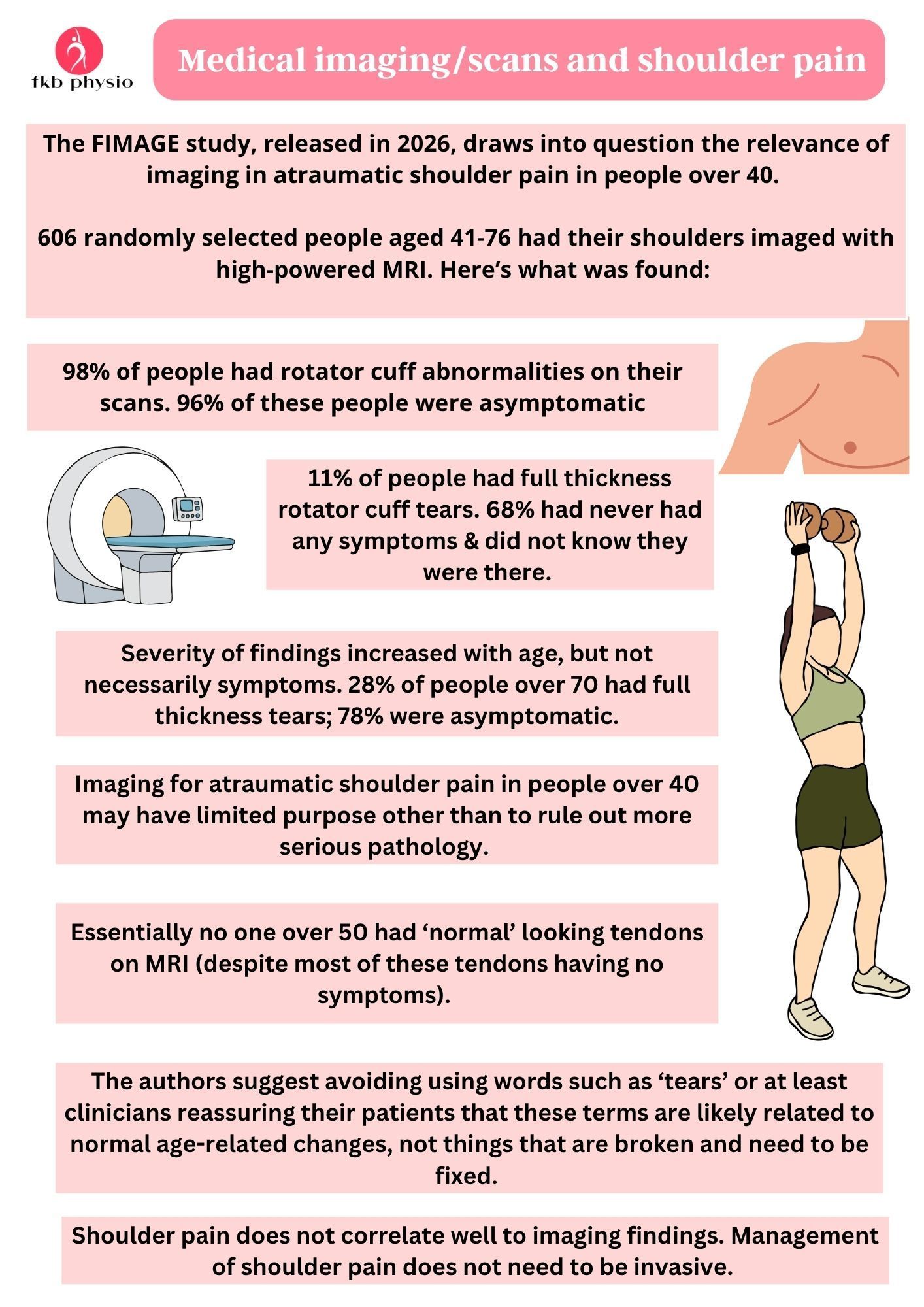
In February this year, the FIMAGE study was released, which looked at the correlation between imaging findings (on strong, powerful MRI machines, reviewed by multiple radiographers) and pain in the shoulder.
The study involved 602 Finnish participants aged 41 to 76 who were randomly selected.
Main findings
The main finding of the study was that nearly everyone (98.7% of participants) had some sort of abnormality on imaging, regardless of whether they had had shoulder pain or not.
- 96% of people with absolutely no shoulder symptoms had abnormalities on imaging, compared with 98% of people with shoulder symptoms (a 2% difference only).
- 11% of people scanned had full thickness rotator cuff tears. 68% had never had shoulder symptoms.
- This number increased relative to age, with 28% of people over 70 having full thickness tears, of whom 78% had no symptoms.
- Severity of findings on imaging generally increased with age.
- Almost no one over 50 had a ‘normal’ looking tendon on imaging.
What does this mean?
Shoulder pain is an extremely common complaint, with a lifetime prevalence of nearly 67% - that is, 67% of people will experience shoulder pain at some point or another during their life. It is common place for those with shoulder pain to be referred for imaging, and treatments are often suggested in response to the findings of that imaging.
It makes sense - you hear that you have a torn tendon; the logical solution sounds like it needs to be repaired. However, it is not that clear cut when so many asymptomatic shoulders look similar on imaging.
(Remember that this study relates to observations of a population over 40. It is not referring to younger shoulders or shoulders that have undergone any sort of trauma).
Recommendations going forward
The authors of the study suggest that we should reconsider the use of the language on these scans, and as clinicians helping patients to understand their scans, we should interpret them more accurately as showing harmless signs of ageing similar to greying hair or wrinkles rather than implying that something is broken that needs to be fixed.
They suggest that imaging may not necessarily required for routine shoulder pain (i.e. shoulder pain that has not come about from a traumatic incident and does not have any red flags associated with it that warrant referral for a scan).
This does not mean that there are no appropriate treatments for sore shoulders; rather that shoulders can be sore for a multitude of reasons, often not well correlated to scans, and can be managed without needing to ‘fix’ anything specific.
Reference:
Ibounig T, Järvinen TLN, Raatikainen S, Härkänen T, Sillanpää N, Bensch F, Haapamäki V, Toivonen P, Björkenheim R, Ryösä A, Kanto K, Lepola V, Joukainen A, Paavola M, Koskinen S, Rämö L, Buchbinder R, Taimela S. Incidental Rotator Cuff Abnormalities on Magnetic Resonance Imaging. JAMA Intern Med. 2026 Apr 1;186(4):406-414. doi: 10.1001/jamainternmed.2025.7903. PMID: 41697693; PMCID: PMC12910452. https://pmc.ncbi.nlm.nih.gov/articles/PMC12910452/
And for a great break down check out the shoulder physio’s podcast and blog post: https://www.shoulderphysio.com/blog/99-of-people-over-40-have-a-rotator-cuff-abnormality-on-mri